Showing posts with label storytelling activity. Show all posts

Wednesday, November 26, 2014

Dialogue and Dancing! New Storytelling Activities

Children Playing Musical Chairs
Antique Postcard, 1910
I have taught storytelling for almost 13 years and have noticed that combining written assignments for a specific storytelling tool, followed by a game that reinforces their writing, is very effective. This week I decided to try new written and interactive activity to help my students balance narrative and dialogue in their stories.
First, I gave them the Language Ladder exercise to help them recognize where they could use dialogue on sections too heavy with narration.
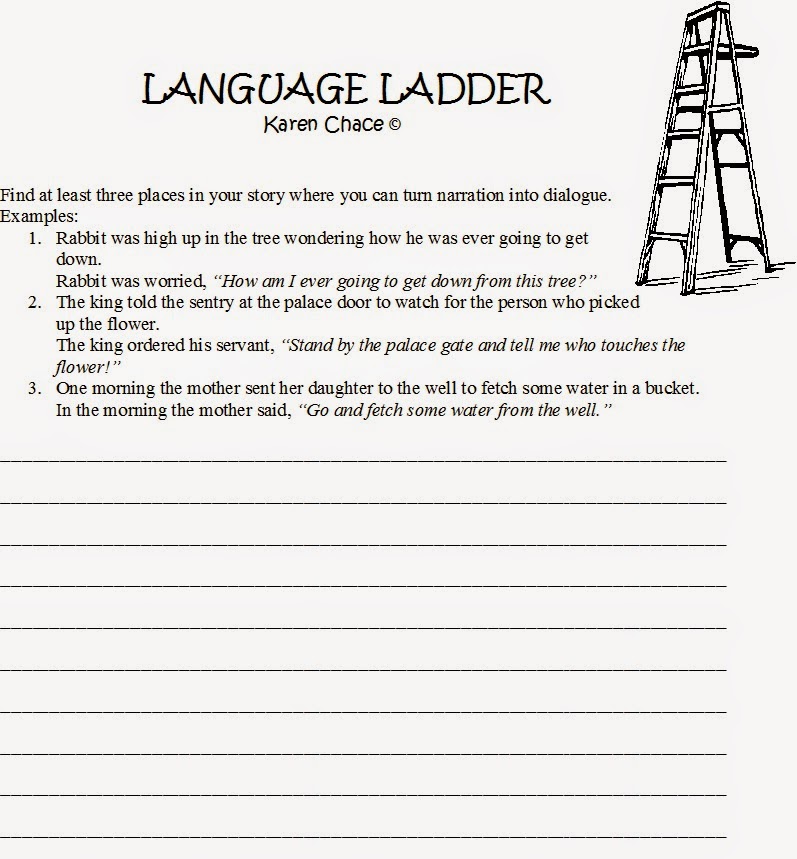


I shared the examples on the handout, asking them to change narrative to dialogue to be sure they understood the process.  They were then instructed to find three places in their stories where they could do the same. Some needed a bit of guidance while others immediately found ways to move the story forward.  Here are some of the changes they made:


  • Original sentence: When the old woman saw what had happened, she was very discouraged about raising bananas.
  • New Sentence: The old woman was very discouraged. “What will I ever do? I can no longer raise bananas!” 
  • Original Sentence: The monkey with the loudest voice was to shout his loudest to the sun and ask for help.
  • New Sentence: “Sun! Come help us! Our friend is stuck!” 
  • Original Sentence: She avoided reflections and mirrors at all costs.
  • New Sentence: “I must never look in a mirror again.”

After they shared their work we moved to an interactive exercise.  I arranged the chairs, front to back, for the game Musical Chairs. Joey, one of my students, cued up the song Happy by Pharrell Williams on his IPhone and the game began.  They had a blast singing and dancing to the music as they tried their best to ensure they were not the one left without a chair. When I stopped the music, the student left standing chose a line of dialogue from their written works, delivering it as the character, complete with vocal expression and body language. Everyone had a great time and the students left to watch the game danced and cheered everyone on.

Afterwards, we stepped outside into the enclosed, library courtyard. (It was a beautiful, warm day and they were delighted to be in the fresh air!)
 I lined everyone up with enough space between them so they wouldn’t bump into each other, tandem students with their partners. They were then asked to tell their stories aloud as they circled the courtyard, adding the new dialogue they created from the written exercise. Not only did this reinforce the previous activities, but it had the added benefit of helping them find additional, natural gestures to include in their telling. 

It was a good day! It reinforced the storytelling tools and added fun and camaraderie to our time together. In this season of thanks I am grateful for the opportunity to work with these amazing children who are always willing to work and play!

Y
ou can find more original written and interactive exercises for your storytelling troupe in my new book, Story by Story: Creating a School Storytelling Troupe. And if you missed last week's new storytelling activity, Dicing Up Your Story, you can find it at the link. http://www.karenchace.blogspot.com/2014/11/dicing-up-your-story-new-storytelling.html

Please let
me know if you find these activities useful in your work; I would love to hear your thoughts.
 

Karen Chace 2014 ©

This blog post was researched and compiled by Karen Chace. Permission for private use is granted. Distribution, either electronically or on paper is prohibited without my expressed written permission. For permission please contact me at storybug@aol.com. Of course, if you wish to link to my blog via your website, blog, newsletter, Facebook page or Twitter please feel free to do so; I greatly appreciate your support and personal integrity.


Wednesday, November 19, 2014

Dicing Up Your Story: New Storytelling Activity

Song Dynasty
by
Su Hanchen, mid 12th Century
Yesterday I met with my sixth and seventh grade storytelling troupe. They have already selected their stories so we spent some time identifying where they could add gestures as they told their tales.

I began by asking them to tell aloud, separately, and simultaneously. As I walked around the room, listening and watching, I noticed many natural movements coming to life.  One student, Soraya, was completely immersed in the story; her body bent forward, arms outstretched, her face displaying all the hallmarks of an intense conversation as she spoke some of the dialogue. So convincing was her body language I had to look twice to see if she was actually speaking with another student. When I remarked on it later during our discussion, she was surprised by my description. She truly didn’t realize what she was doing; it was a natural extension of stepping into her story.


After everyone finished I asked them to complete the written exercise,
Giant Gestures, then called everyone into a circle. Using a large, foam dice each student took turns tossing it. Whatever number came up they performed that number of gestures from their story, while explaining the part of the story the gesture complemented. Since the numbers went from one to six, and the written exercise only asked for five gestures, if six came up they shared five gestures and one facial expression.


They had a great time and didn’t want to stop. Luke, another student asked, “Do you know the Wonder Ball song?” He suggested we pass the dice as we sang the song, and the student left holding the dice would share a gesture. I liked the idea and added, “Since three is the magic number in fairytales let’s share two gestures and one facial expression.” Once a student was ‘out’ they sat in the middle of the circle urging their friends on.

I can easily imagine this dice being used for other story parts as well. Perhaps you might attach something specific to each number. For example:
#1 = gesture
#2 = two lines of dialogue
#3 = three facial expressions
#4 = four adjectives to describe someone in your story

#5 = use your five senses to describe the setting of your story

#6 = share six (major or minor) events that happen in your story

* These games are free for you to use in your work. However, I  do ask that you respect copyright and offer attribution.
 
After both games they completed a second written exercise, Story Snapshot. I was delighted to read the highly descriptive and detailed answers they gave for the questions. The combination of telling their stories aloud, completing Giant Gestures first, transitioning to activities that engaged the entire body, and back to one last written exercise, Story Snapshot, worked! The entire process complemented and reinforced their gestures, facial expression, story sequence, imagination, and team spirit, and they had fun in the process!

Next week I will try out a new activity, based on another childhood game. I will let you know how it turns out!
* Both exercises, Giant Gestures and Story Snapshot can be found in my book,
Story by Story: Creating a Student Storytelling Troupe.


Note: Yes, I know that normally the singular for dice is die. However, when I double checked before posting the blog this is what I read: The New Oxford Dictionary of English, Judy Pearsall, Patrick Hanks (1998) states that “In modern standard English, the singular die (rather than dice) is uncommon. Dice is used for both the singular and the plural.”


Karen Chace 2014 ©
This blog post was researched and compiled by Karen Chace. Permission for private use is granted. Distribution, either electronically or on paper is prohibited without my expressed written permission. For permission please contact me at storybug@aol.com. Of course, if you wish to link to my blog via your website, blog, newsletter, Facebook page or Twitter please feel free to do so; I greatly appreciate your support and personal integrity.